
BALENCIAGA/Balenciaga Cola Wave Half-Zip Pit Knitted Sweater Ready-made garments are made of longitudinal pit texture knitted gray fabric. The weaving stage has high standards for yarn tension and machine yarn feeding speed. The width of the vertical grooves and the concave and convex texture of the entire body of the garment must be highly uniform. The production process is prone to defects such as texture deviation and density gaps, and the gray fabric screening loss is large. After the gray fabric is off the machine, it is pre-shrunk and heat-set to release the potential shrinkage of the fabric in advance and prevent the subsequent distortion and size deformation of the finished garments in the washing water. The body of the garment is equipped with a half-zip stand-up collar structure. The collar ribs and body pit stripes require vertical alignment, and the splicing process requires precise alignment of the texture direction. The zipper welt uses a blind-stitching process to ensure smooth opening and closing of the zipper and avoid local vertical grain stretch deformation caused by sewing pull. Sewing workers need to continuously control the fabric feeding tension to balance the elasticity of the fabric and the stability of the threading. Drop-shoulder silhouette pieces are cut strictly along the pitted texture to prevent diagonal cuts from damaging the fabric texture. The printing of the wave monogram on the back is the core technical difficulty of this model. The surface of the concave and convex pit fabric is undulating and cannot be printed directly like flat fabrics. During production, the tension of the printing area is first fixed and leveled, and the layered alignment offset printing process is used to complete the printing of wave graphics and letter logos in sequence. Multi-layer pattern overprinting requires extremely high precision, and it is easy to produce ghosting and misalignment defects. The ink ratio has been adjusted to take into account the fullness of the pattern and ensure that the printing is not prone to cracking and falling off when the fabric is stretched. The cuffs and hem ribs are woven from pitted fabrics of the same system, and the elastic density matches the body parameters to avoid problems with elasticity imbalance and wavy edges after wearing. After the garments are sewn, detailed inspection is carried out to screen for sewing defects and printing defects. Finally, the low-temperature wet finishing process is used to uniformly correct the pattern and texture flatness. From knitting and weaving, precision cutting, structural sewing, multi-layer overprinting to garment styling, the process chain is complicated. Failure to control any process standard will directly affect the overall look and feel of the garment. Size:XS S M L
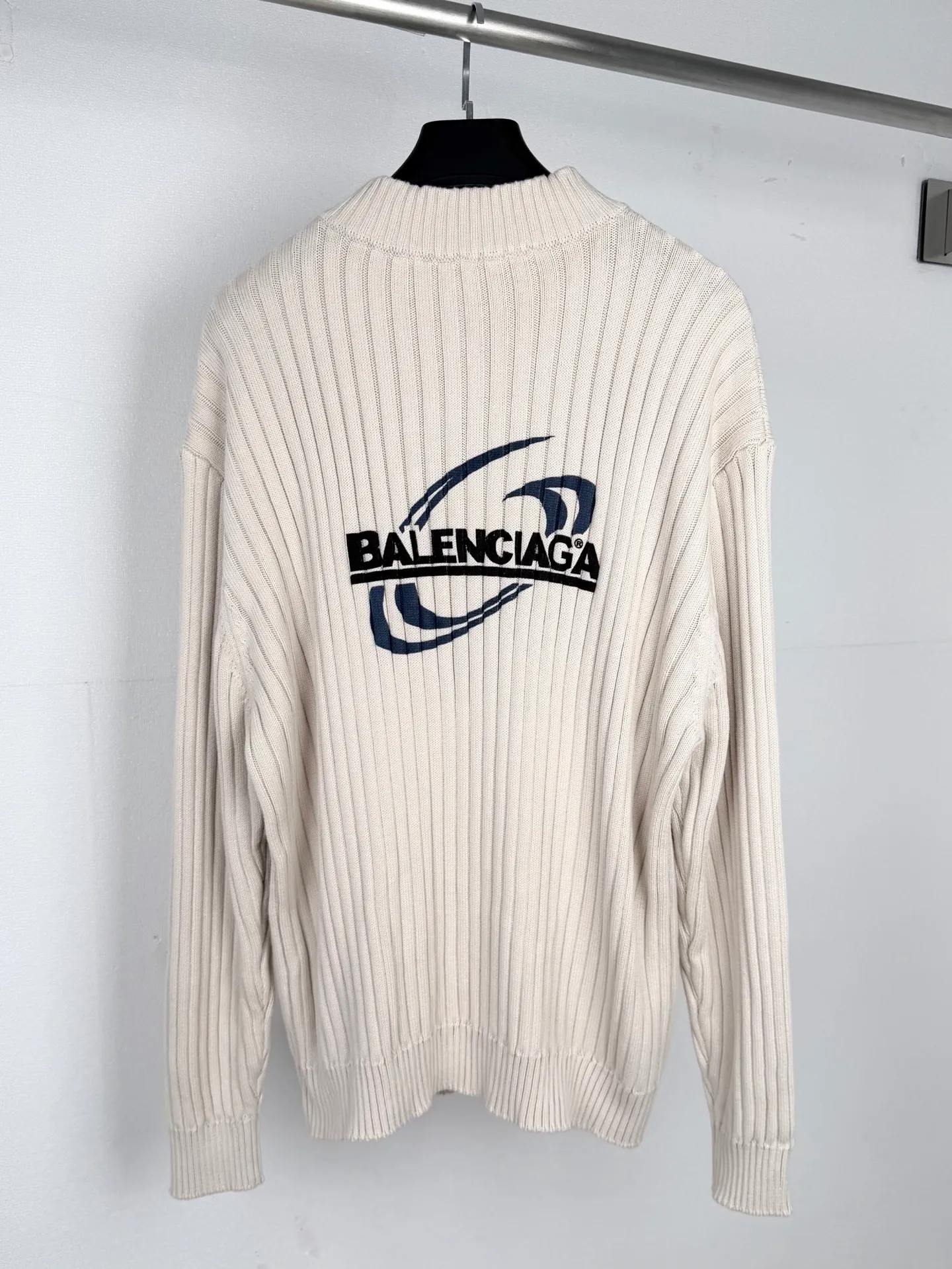
BALENCIAGA/Balenciaga Cola Wave Half-Zip Pit Knitted Sweater Ready-made garments are made of longitudinal pit texture kn...
BALENCIAGA/Balenciaga Cola Wave Half-Zip Pit Knitted Sweater The ready-made garments are made of longitudinal pit texture knitted gray fabric. The weaving stage has high standards for yarn tension and machine yarn feeding speed. The width of the vertical grooves and the concave and convex texture of the entire body of the garment must be highly uniform. The production process is prone to defects such as texture deviation and density gaps, and the screening loss of gray fabric is large. After the gray fabric is off the machine, it is pre-shrunk and heat-set to release the potential shrinkage of the fabric in advance and prevent the subsequent distortion and size deformation of the finished garments in the washing water. The body of the garment is equipped with a half-zip stand-up collar structure. The collar ribs and body pit stripes require vertical alignment, and the splicing process requires precise alignment of the texture direction. The zipper welt uses a blind-stitching process to ensure smooth opening and closing of the zipper and avoid local vertical grain stretch deformation caused by sewing pull. Sewing workers need to continuously control the fabric feeding tension to balance the elasticity of the fabric and the stability of the threading. Drop-shoulder silhouette pieces are cut strictly along the pitted texture to prevent diagonal cuts from damaging the fabric texture. The printing of the wave monogram on the back is the core technical difficulty of this model. The surface of the concave and convex pit fabric is undulating and cannot be printed directly like flat fabrics. During production, the tension of the printing area is first fixed and leveled, and the layered alignment offset printing process is used to complete the printing of wave graphics and letter logos in sequence. Multi-layer pattern overprinting requires extremely high precision, and it is easy to produce ghosting and misalignment defects. The ink ratio has been adjusted to take into account the fullness of the pattern and ensure that the printing is not prone to cracking and falling off when the fabric is stretched. The cuffs and hem ribs are woven from pitted fabrics of the same system, and the elastic density matches the body parameters to avoid problems with elasticity imbalance and wavy edges after wearing. After the garments are sewn, detailed inspection is carried out to screen for sewing defects and printing defects. Finally, the low-temperature wet finishing process is used to uniformly correct the pattern and texture flatness. From knitting and weaving, precision cutting, structural sewing, multi-layer overprinting to garment styling, the process chain is complicated. Failure to control any process standard will directly affect the overall look and feel of the garment. Size:XS S M L
BALENCIAGA/Balenciaga Cola Wave Half-Zip Pit Knitted Sweater Ready-made garments are made of longitudinal pit texture knitted gray fabric. The weaving stage has high standards for yarn tension and machine yarn feeding speed. The width of the vertical grooves and the concave and convex texture of the entire body of the garment must be highly uniform. The production process is prone to defects such as texture deviation and density gaps, and the gray fabric screening loss is large. After the gray fabric is off the machine, it is pre-shrunk and heat-set to release the potential shrinkage of the fabric in advance and prevent the subsequent distortion and size deformation of the finished garments in the washing water. The body of the garment is equipped with a half-zip stand-up collar structure. The collar ribs and body pit stripes require vertical alignment, and the splicing process requires precise alignment of the texture direction. The zipper welt uses a blind-stitching process to ensure smooth opening and closing of the zipper and avoid local vertical grain stretch deformation caused by sewing pull. Sewing workers need to continuously control the fabric feeding tension to balance the elasticity of the fabric and the stability of the threading. Drop-shoulder silhouette pieces are cut strictly along the pitted texture to prevent diagonal cuts from damaging the fabric texture. The printing of the wave monogram on the back is the core technical difficulty of this model. The surface of the concave and convex pit fabric is undulating and cannot be printed directly like flat fabrics. During production, the tension of the printing area is first fixed and leveled, and the layered alignment offset printing process is used to complete the printing of wave graphics and letter logos in sequence. Multi-layer pattern overprinting requires extremely high precision, and it is easy to produce ghosting and misalignment defects. The ink ratio has been adjusted to take into account the fullness of the pattern and ensure that the printing is not prone to cracking and falling off when the fabric is stretched. The cuffs and hem ribs are woven from pitted fabrics of the same system, and the elastic density matches the body parameters to avoid problems with elasticity imbalance and wavy edges after wearing. After the garments are sewn, detailed inspection is carried out to screen for sewing defects and printing defects. Finally, the low-temperature wet finishing process is used to uniformly correct the pattern and texture flatness. From knitting and weaving, precision cutting, structural sewing, multi-layer overprinting to garment styling, the process chain is complicated. Failure to control any process standard will directly affect the overall look and feel of the garment. Size:XS S M L
2026-10-29
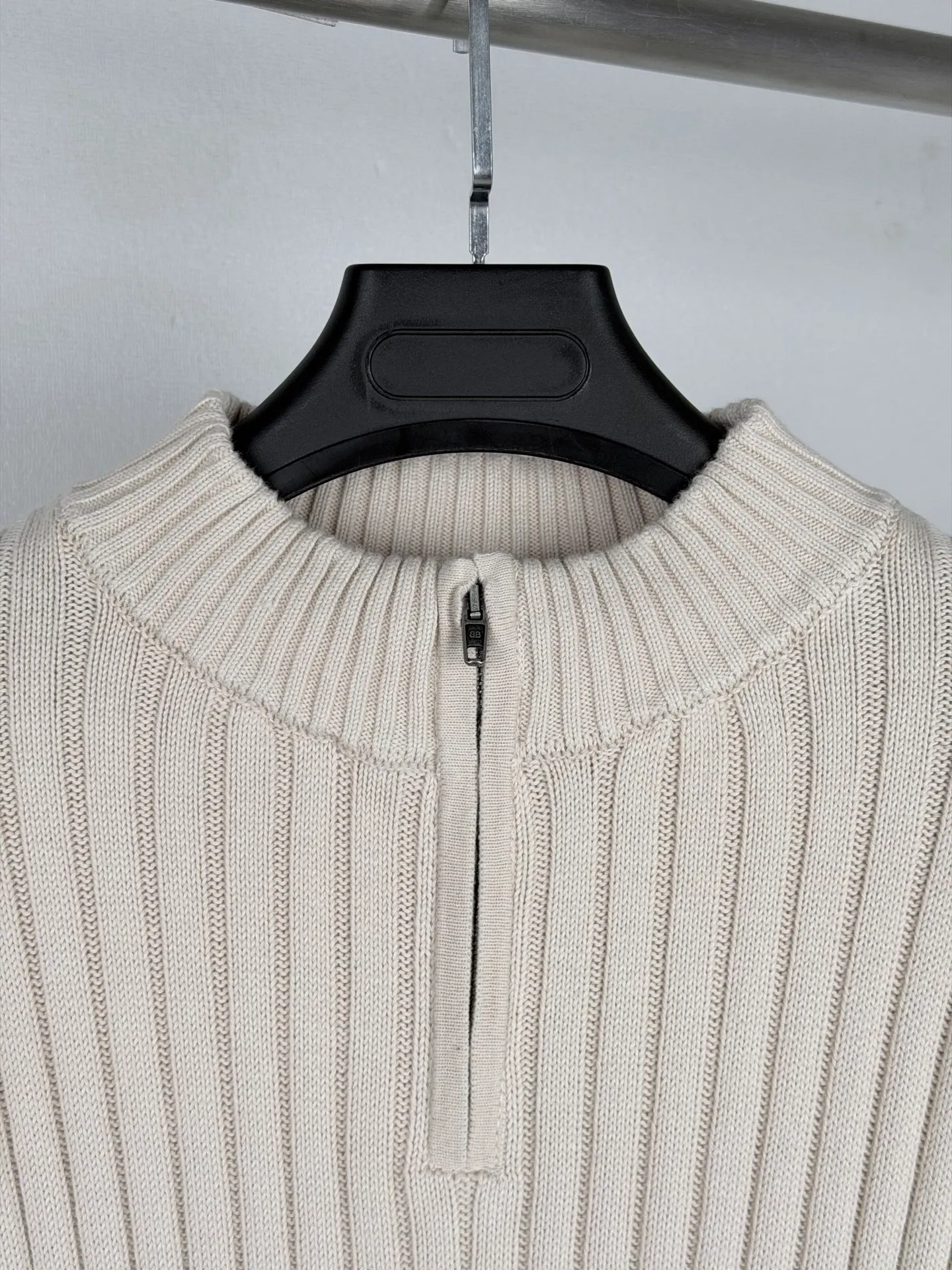
BALENCIAGA/Balenciaga Cola Wave Half-Zip Pit Knitted Sweater Ready-made garments are made of longitudinal pit texture knitted gray fabric. The weaving stage has high standards for yarn tension and machine yarn feeding speed. The width of the vertical grooves and the concave and convex texture of the entire body of the garment must be highly uniform. The production process is prone to defects such as texture deviation and density gaps, and the gray fabric screening loss is large. After the gray fabric is off the machine, it is pre-shrunk and heat-set to release the potential shrinkage of the fabric in advance and prevent the subsequent distortion and size deformation of the finished garments in the washing water. The body of the garment is equipped with a half-zip stand-up collar structure. The collar ribs and body pit stripes require vertical alignment, and the splicing process requires precise alignment of the texture direction. The zipper welt uses a blind-stitching process to ensure smooth opening and closing of the zipper and avoid local vertical grain stretch deformation caused by sewing pull. Sewing workers need to continuously control the fabric feeding tension to balance the elasticity of the fabric and the stability of the threading. Drop-shoulder silhouette pieces are cut strictly along the pitted texture to prevent diagonal cuts from damaging the fabric texture. The printing of the wave monogram on the back is the core technical difficulty of this model. The surface of the concave and convex pit fabric is undulating and cannot be printed directly like flat fabrics. During production, the tension of the printing area is first fixed and leveled, and the layered alignment offset printing process is used to complete the printing of wave graphics and letter logos in sequence. Multi-layer pattern overprinting requires extremely high precision, and it is easy to produce ghosting and misalignment defects. The ink ratio has been adjusted to take into account the fullness of the pattern and ensure that the printing is not prone to cracking and falling off when the fabric is stretched. The cuffs and hem ribs are woven from pitted fabrics of the same system, and the elastic density matches the body parameters to avoid problems with elasticity imbalance and wavy edges after wearing. After the garments are sewn, detailed inspection is carried out to screen for sewing defects and printing defects. Finally, the low-temperature wet finishing process is used to uniformly correct the pattern and texture flatness. From knitting and weaving, precision cutting, structural sewing, multi-layer overprinting to garment styling, the process chain is complicated. Failure to control any process standard will directly affect the overall look and feel of the garment. Size:XS S M L
2026-10-29