Chinese supplier factory
exclusively supplying wholesalers, resellers, and retailers.
Click here to contact us
Scan QR Code

| Premium Select

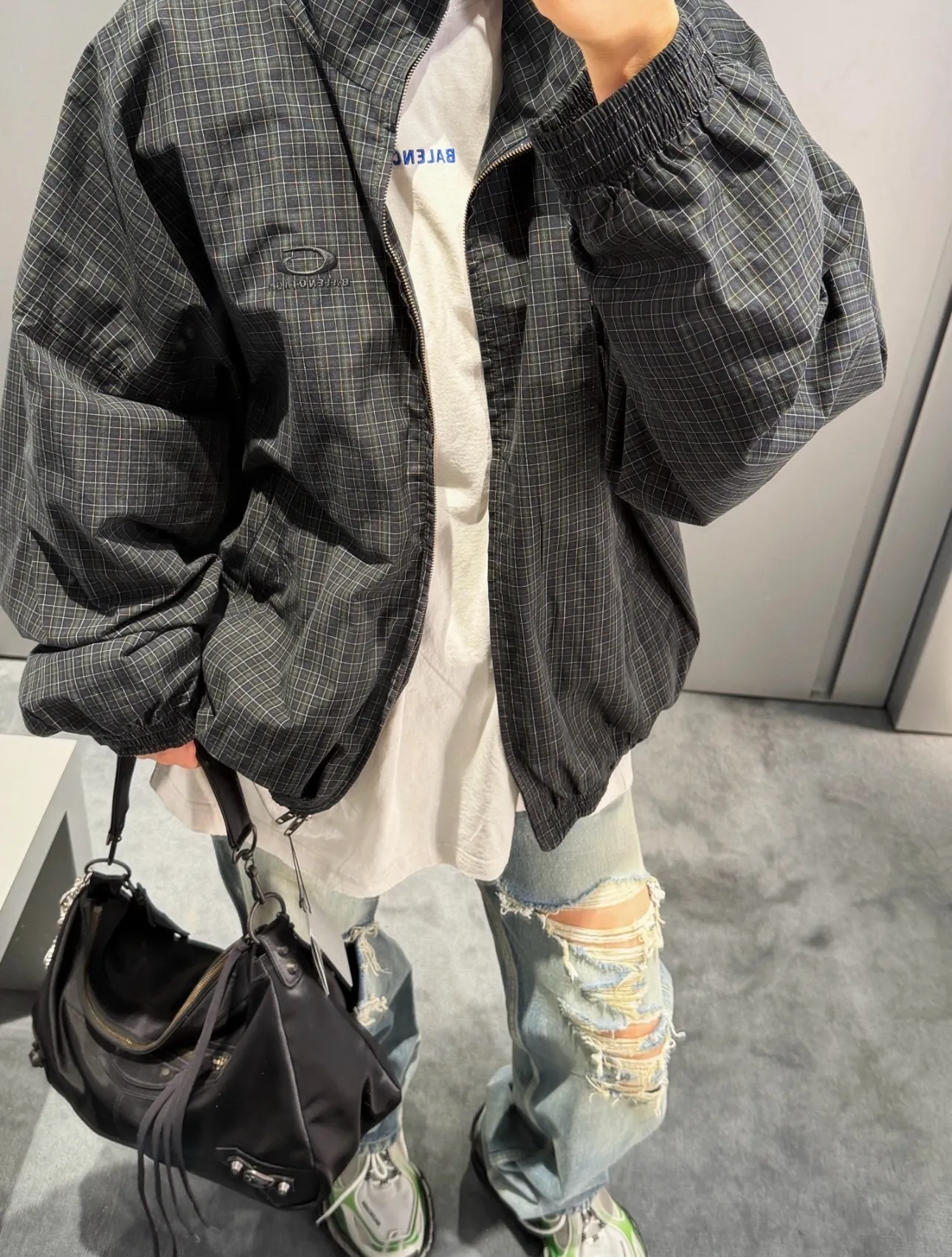
Balenciaga SS 26 two-way zipper opening and closing embroidered plaid jacket is based on the technology of full-area no-dead-corner plaid technology, superimposed on multiple difficult processes such as a two-way zipper composite structure, positioning heavy embroidery, and full-piece symmetrical sewing. The complexity of the process and the scrap rate far exceed that of conventional ready-to-wear. It is a ceiling-level presentation of street luxury craftsmanship. This product is made of custom-made yarn-dyed plaid original fabric. It needs to complete four pre-processing processes of ultra-dense pre-shrinking, weft density correction, tension leveling and flat-width shaping before being put into production. The shrinkage error of the fabric's longitude and latitude is strictly controlled within 0.2%, which completely eliminates the hidden dangers of plaid deformation and alignment deviation after the garment is worn, laying an irreplaceable foundation for the whole piece to align. The pre-processing time of a single fabric is three times that of an ordinary jacket. The core process difficulty is the full-area through-alignment technology, which requires all exposed pieces such as the front and rear panels of the body, large and small sleeve panels, lapel collars, pocket flap welts, placket stops, and side seam panels to achieve horizontal penetration of horizontal grids, vertical alignment of vertical grids, and complete mirror symmetry of left and right panels. The alignment tolerance is strictly controlled within 0.1mm, and the industry standard is only 0.5mm. Cutting pieces are arranged using a zero-loss precise positioning method. The loss rate of a single fabric is increased by 20%. Any deviation in the pattern of the cutting pieces is judged as a defective product. The experience and precision requirements of the cutting masters have reached a strict level. At the structural level, it is equipped with a two-way double-head customized zipper opening and closing system. The zipper tooth chain and placket pattern must be 100% aligned in the center seam. When the zipper is installed, the plaid alignment and stop smoothness are simultaneously completed to prevent the plaid from being pulled or skewed due to zipper installation. The front loop sportsicon heavy embroidery adopts positioning embedded technology. The embroidery stitches need to accurately follow the warp and weft direction of the check pattern. The positioning error of the embroidery frame does not exceed 0.05mm. The floating embroidery process avoids the stitch tension from pulling the fabric texture and achieves the perfect symbiosis between the embroidery pattern and the check texture. The entire garment adopts segmented alignment sewing and full-process quality inspection and control. From cut pieces to finished products, it needs to undergo 7 alignment checks. Every seam, structural line, and decorative piece serves the integrity of the pattern. The complexity of the process, labor cost, and quality control standards are all benchmarked against the high-end garment level. It has both pioneering design and unrepeatable ingenious workmanship. Size: 46 48 50 52
9
Balenciaga SS 26 two-way zipper opening and closing embroidered plaid jacket is based on the technology of full-area no-dead-corner plaid technology, superimposed on multiple difficult processes such as a two-way zipper composite structure, positioning heavy embroidery, and full-piece symmetrical sewing. The complexity of the process and the scrap rate far exceed that of conventional ready-to-wear. It is a ceiling-level presentation of street luxury craftsmanship. This product is made of custom-made yarn-dyed plaid original fabric. It needs to complete four pre-processing processes of ultra-dense pre-shrinking, weft density correction, tension leveling and flat-width shaping before being put into production. The shrinkage error of the fabric's longitude and latitude is strictly controlled within 0.2%, which completely eliminates the hidden dangers of plaid deformation and alignment deviation after the garment is worn, laying an irreplaceable foundation for the whole piece to align. The pre-processing time of a single fabric is three times that of an ordinary jacket. The core process difficulty is the full-area through-alignment technology, which requires all exposed pieces such as the front and rear panels of the body, large and small sleeve panels, lapel collars, pocket flap welts, placket stops, and side seam panels to achieve horizontal penetration of horizontal grids, vertical alignment of vertical grids, and complete mirror symmetry of left and right panels. The alignment tolerance is strictly controlled within 0.1mm, and the industry standard is only 0.5mm. Cutting pieces are arranged using a zero-loss precise positioning method. The loss rate of a single fabric is increased by 20%. Any deviation in the pattern of the cutting pieces is judged as a defective product. The experience and precision requirements of the cutting masters have reached a strict level. At the structural level, it is equipped with a two-way double-head customized zipper opening and closing system. The zipper tooth chain and placket pattern must be 100% aligned in the center seam. When the zipper is installed, the plaid alignment and stop smoothness are simultaneously completed to prevent the plaid from being pulled or skewed due to zipper installation. The front loop sportsicon heavy embroidery adopts positioning embedded technology. The embroidery stitches need to accurately follow the warp and weft direction of the check pattern. The positioning error of the embroidery frame does not exceed 0.05mm. The floating embroidery process avoids the stitch tension from pulling the fabric texture and achieves the perfect symbiosis between the embroidery pattern and the check texture. The entire garment adopts segmented alignment sewing and full-process quality inspection and control. From cut pieces to finished products, it needs to undergo 7 alignment checks. Every seam, structural line, and decorative piece serves the integrity of the pattern. The complexity of the process, labor cost, and quality control standards are all benchmarked against the high-end garment level. It has both pioneering design and unrepeatable ingenious workmanship. Size: 46 48 50 52
2026-10-29
Balenciaga plaid splicing fake two-piece denim jacket is deconstructed and spliced ​​with cotton plaid fabric and heavy denim. It combines strict grid technology, fake two-piece composite structure and multiple washing and distressing treatments. The overall process complexity and production accuracy have reached Premium fashion-level standards. The process is complicated and the error tolerance rate is extremely low. The fabric uses a dual-material composite system. The outer layer is made of high-weight combed cotton denim, which has good stiffness and structural support. The inner layer is matched with high-density yarn-dyed plaid cotton fabric. The warp and weft yarns are arranged regularly and the color fastness is stable. The weight, elasticity, and shrinkage of the two fabrics are significantly different. Multiple pre-treatments such as pre-shrinking, shaping, and hair removal are required in the early stage to ensure that problems such as wrinkles, uneven shrinkage, and splicing misalignment will not occur during the later sewing and washing processes. The fabric preparation process alone is far superior to conventional single-fabric jackets. The core technical difficulty is focused on the precise grid alignment of the entire garment. From the lapels, plackets, chest pockets to cuffs and side seams, all splicing parts require the horizontal and vertical lines of the grid to be continuously aligned and symmetrical. At the cutting bed stage, manual positioning and typesetting and laser precision cutting are used. Each piece is independently calibrated to the grid position. Batch trimming is prohibited to ensure alignment accuracy. Detailed areas such as breast pockets and placket need to be individually tailored and aligned twice. The fabric loss rate and working time cost are doubled. Any millimeter-level deviation will lead to the scrapping of the cut pieces, which requires extremely high technician experience and equipment accuracy. The fake two-piece composite structure further increases the difficulty of production. The inner and outer double-layer independent panels are nested and sewn. The outer layer is in the shape of a Classic denim jacket, and the inner layer presents a plaid shirt-like visual effect. The collar, placket, hem, and cuffs all achieve double-layer natural overlapping. During production, the inner and outer layers of semi-finished products need to be completed separately, and then accurately aligned and stitched to control the size matching and movement margin of the two layers to avoid shifting, warping, and tightness between layers. The sewing process requires multiple manual positioning and fixings to take into account the layered appearance and wearing comfort. The sewing process follows high-standard fashion standards, using professional techniques such as buried clips, double-thread lockstitching, and reinforced backstitching. Button positioning and chest pocket sewing need to be calibrated before installation. The loose shoulder design is combined with three-dimensional tailoring. The shoulder line and armholes are pulled back to enhance the stiffness of the version. The stitches throughout the garment are even and dense, the seams are smooth and wrinkle-free, the hardware accessories are installed firmly and neatly, and the details are handled rigorously. The washing process adopts a multiple compound distressing system, combining enzyme washing, sand washing, light horse washing and garment styling washing, and manual assisted partial whitening to create a natural retro texture. At the same time, the shrinkage of the inner and outer layers of fabrics is strictly controlled to prevent deformation, plaid shift and uneven color after washing. Each washing process requires manual control of intensity and duration, making it impossible to fully standardize mass production. The final product has both aged texture and pattern stability. The entire jacket has gone through dozens of processes, integrating high-precision grid alignment, complex structural splicing, and multiple washes and distressing. The process chain is long, there are many control points, and there is very little room for error. It fully reflects the ultimate complexity of Premium fashion in material matching, structural design, and craftsmanship. Size:XS S M L
8
Balenciaga plaid splicing fake two-piece denim jacket is deconstructed and spliced ​​with cotton plaid fabric and heavy denim. It combines strict grid technology, fake two-piece composite structure and multiple washing and distressing treatments. The overall process complexity and production accuracy have reached Premium fashion-level standards. The process is complicated and the error tolerance rate is extremely low. The fabric uses a dual-material composite system. The outer layer is made of high-weight combed cotton denim, which has good stiffness and structural support. The inner layer is matched with high-density yarn-dyed plaid cotton fabric. The warp and weft yarns are arranged regularly and the color fastness is stable. The weight, elasticity, and shrinkage of the two fabrics are significantly different. Multiple pre-treatments such as pre-shrinking, shaping, and hair removal are required in the early stage to ensure that problems such as wrinkles, uneven shrinkage, and splicing misalignment will not occur during the later sewing and washing processes. The fabric preparation process alone is far superior to conventional single-fabric jackets. The core technical difficulty is focused on the precise grid alignment of the entire garment. From the lapels, plackets, chest pockets to cuffs and side seams, all splicing parts require the horizontal and vertical lines of the grid to be continuously aligned and symmetrical. At the cutting bed stage, manual positioning and typesetting and laser precision cutting are used. Each piece is independently calibrated to the grid position. Batch trimming is prohibited to ensure alignment accuracy. Detailed areas such as breast pockets and placket need to be individually tailored and aligned twice. The fabric loss rate and working time cost are doubled. Any millimeter-level deviation will lead to the scrapping of the cut pieces, which requires extremely high technician experience and equipment accuracy. The fake two-piece composite structure further increases the difficulty of production. The inner and outer double-layer independent panels are nested and sewn. The outer layer is in the shape of a Classic denim jacket, and the inner layer presents a plaid shirt-like visual effect. The collar, placket, hem, and cuffs all achieve double-layer natural overlapping. During production, the inner and outer layers of semi-finished products need to be completed separately, and then accurately aligned and stitched to control the size matching and movement margin of the two layers to avoid shifting, warping, and tightness between layers. The sewing process requires multiple manual positioning and fixings to take into account the layered appearance and wearing comfort. The sewing process follows high-standard fashion standards, using professional techniques such as buried clips, double-thread lockstitching, and reinforced backstitching. Button positioning and chest pocket sewing need to be calibrated before installation. The loose shoulder design is combined with three-dimensional tailoring. The shoulder line and armholes are pulled back to enhance the stiffness of the version. The stitches throughout the garment are even and dense, the seams are smooth and wrinkle-free, the hardware accessories are installed firmly and neatly, and the details are handled rigorously. The washing process adopts a multiple compound distressing system, combining enzyme washing, sand washing, light horse washing and garment styling washing, and manual assisted partial whitening to create a natural retro texture. At the same time, the shrinkage of the inner and outer layers of fabrics is strictly controlled to prevent deformation, plaid shift and uneven color after washing. Each washing process requires manual control of intensity and duration, making it impossible to fully standardize mass production. The final product has both aged texture and pattern stability. The entire jacket has gone through dozens of processes, integrating high-precision grid alignment, complex structural splicing, and multiple washes and distressing. The process chain is long, there are many control points, and there is very little room for error. It fully reflects the ultimate complexity of Premium fashion in material matching, structural design, and craftsmanship. Size:XS S M L
2026-10-29